CookieRun: Tower of Adventures
- 4.6
- Rating
- 1.00M
- Installs
- Free
- Price

 Analysis by App-foxy
My first impression of CookieRun: Tower of Adventures was that it wants to feel cheerful without becoming weightless. It is an action game built around a bright 3D CookieRun world, but the colorful presentation is not the whole point. The real test is whether the movement, encounters, timing, and visual feedback work together well enough to make short sessions satisfying. After spending time with it, I found a game that is easy to approach, lively to look at, and more deliberate than its soft character designs initially suggest.
That combination makes it a comfortable recommendation for players who like accessible mobile action games with a strong animated identity. It is free to start, rated for Everyone, and developed by Devsisters Corporation. The game has also attracted an average rating of 4.6 from around 142 thousand ratings, which matches my general impression: it is polished enough to make a quick first session enjoyable, while still leaving room for personal preferences about repetition, spending, and the pace of progression.
A bright first impression that quickly becomes playable
The opening experience does a good job of making the game readable. Characters have clear silhouettes, attacks are visually distinct, and the environments use color to separate background decoration from the spaces where action matters. That clarity is important on a phone, where a crowded scene can make it difficult to understand what is happening under a thumb. Here, the presentation usually points my attention toward the next threat, the next route, or the next moment that needs a response.
You May Also Like

 Blood Strike: 2.5 Anniversary
Blood Strike’s Loadouts Turn Every Drop Into a Tactical Gamble
A close look at Blood Strike’s custom loadouts: how fast access to signature weapons reshapes its battle royale rhythm, rewards preparation, and narrows the gap between fights.

 Pandora - Music & Podcasts
Pandora’s Music Is Easy to Start, but Harder to Recover
Pandora’s strength is its low-effort path from a seed to a station. Its weak spot is how much confidence it asks you to place in connection, setup, and quiet recovery.

 8 Ball Pool
 Is Built on Rivalries, Rematches, and Routine
A close look at the rivalries, rematches, shared routines, and unanswered safety questions that turn a quick pool match into a persistent mobile community.

 Samsung Music
’s Quiet Strength Is Playing What You Already Own
Its reach comes less from spectacle than from dependable access to a personal library. That simplicity is both the app’s strongest retention engine and its ceiling.

 AccuWeather: Weather Radar
AccuWeather Review: A Quick, Clear Forecast for Everyday Decisions
For everyday plans, the best forecast is the one you can understand quickly. AccuWeather makes rain timing, radar, and local conditions easy to act on, with a few trade-offs.

 Hill Climb Racing
Why Hill Climb Racing Still Turns Crashes Into One More Run
A tiny car, a bumpy hill and one more upgrade: Hill Climb Racing keeps resurfacing because its simple chaos makes every near-miss feel personal.
More From Our News Desk



I also like that the 3D style gives the CookieRun setting more physical presence than a flat menu-driven presentation would. The Cookies look expressive from different angles, and the world feels arranged as a place rather than a collection of isolated buttons. The sweetness is obvious, but the game does not rely only on cuteness to hold attention. Its action framing gives the characters a little more weight, especially when an attack lands or a character moves through a busy area.
The first few sessions are best approached as a learning period rather than a race toward maximum efficiency. I found it more useful to watch how enemies telegraph danger, how much room an attack occupies, and where the camera places the character before trying to move quickly. That habit pays off because the visual style can make danger look playful. A smiling Cookie and a rounded enemy may soften the mood, but they still require attention when the screen becomes active.
For an everyday scenario, this is the kind of game I would open during a commute or while waiting for an appointment, provided I had enough uninterrupted time to finish a small objective. It is more engaging than a purely passive collector because I need to participate, yet it does not demand the grim seriousness of a competitive action title. The bright tone also makes it easier to play around other people without feeling as though I am carrying an intense battle into a quiet room.
The game is not equally suitable for everyone. If I wanted a deep, traditional action game with complex controls, long uninterrupted stages, and highly technical combat, I would look elsewhere. This experience is designed around mobile accessibility and a playful world. That is a strength for newcomers, but it also means experienced action players may eventually notice that the interaction model is less demanding than what they expect from a console or dedicated handheld game.
The world communicates through shape, color, and movement
CookieRun: Tower of Adventures has a clear visual language. Rounded forms, strong color contrasts, animated reactions, and exaggerated proportions tell me what kind of world I am in before the game explains anything. The setting feels friendly and theatrical rather than realistic. That matters because the game can introduce danger without abandoning its identity: a threatening situation still belongs to a world made from candy-colored imagination.
The art direction also helps distinguish function from decoration. Platforms, hazards, enemies, and interactive spaces tend to have different visual emphasis, so I can scan the scene instead of studying every object. This is particularly helpful when playing on a smaller display. A more detailed or realistic art style might look impressive in screenshots but create visual noise during action. Here, the simplified shapes support the basic job of an action game: showing me where to go and what deserves a response.
One of the less obvious strengths is how the setting supports pacing. A cheerful area can make exploration feel relaxed, while a more crowded or visually intense space prepares me for faster decisions. The game does not need to announce every emotional change with a dramatic explanation. It can use layout, color, and enemy placement to shift the mood. I found myself noticing those changes even when I was concentrating more on movement than story.
That visual consistency is useful when choosing how to play. I can focus on learning the environment first, then improve my combat choices once the route feels familiar. In other words, the art is not simply decoration around the mechanics; it reduces the amount of mental effort needed to understand a new situation. My practical tip is to pause mentally at the start of a new area and identify the safest open space, the likely direction of progress, and the objects that look deliberately emphasized. Doing that is often more valuable than immediately attacking.
There is a trade-off, though. The same friendly presentation that makes the game welcoming can reduce the feeling of danger for players who want a darker or more dramatic atmosphere. The world has personality, but it is not aiming for horror, realism, or heavy emotional storytelling. I would choose it for colorful character action, not for a serious fantasy setting with grim consequences.
Sound gives the action its sense of bounce
The audio presentation works best when it reinforces motion. Bright effects, character reactions, and impact sounds help me understand whether an action connected, missed, or produced a stronger response than usual. In a mobile action game, that feedback is valuable because my finger can cover part of the screen. Sound becomes a second way to read the battle, especially when several visual effects overlap.
The overall mood is buoyant rather than aggressive. That keeps the game coherent with its art direction: the screen can become busy, but the experience still feels like an animated adventure instead of a harsh combat simulator. I appreciate that balance because it makes repeated play less tiring. The soundscape encourages momentum without constantly demanding emotional intensity.
Rhythm is particularly important here. Action feels better when movement, attacks, enemy responses, and stage transitions form a recognizable pattern. Once I start predicting that pattern, I stop reacting randomly and begin making cleaner decisions. My advice is to avoid playing with all feedback muted during the learning phase. Even if I eventually lower the volume, the audio cues can help establish timing and reveal when I have become too eager with an attack.
The limitation is that players who prefer quiet, low-stimulation games may find the combination of colorful visuals and active sound tiring over longer sessions. This is not a criticism of quality so much as a matter of fit. I would use headphones when I wanted to concentrate on timing, but I would also take breaks rather than treating the game as something to leave running continuously in the background.
Compared with slower puzzle games in the same broad mobile entertainment space, this title asks for more immediate attention. Compared with competitive action games, it feels more forgiving and expressive. That middle position is one of its most appealing qualities: it has enough rhythm to make play active, but not so much pressure that every mistake feels like a failure.
Where the mechanics meet the presentation
The strongest part of the experience is the way the visual and mechanical sides usually agree. The Cookies look like characters with distinct personalities, but their presentation also helps me understand how to use them in action. Movement, attacks, and encounters are easier to appreciate when I treat each sequence as a small problem: read the space, choose a safe position, commit to an action, and adjust after seeing the result.
I would not recommend rushing through every encounter by repeatedly pressing the most obvious attack. That approach may work in easier moments, but it teaches poor habits. A better workflow is to watch the first exchange, notice how much time an enemy gives me, and then decide whether positioning or offense is the priority. This is a concrete advantage of the game’s readable art direction: it gives me enough information to improve through observation rather than relying only on trial and error.
The pacing also suits players who like a mixture of activity and reset points. Fast sections feel more manageable when the game gives me a chance to reorient, and calmer moments prevent every minute from blending into one long burst of effects. I found that useful on a phone because attention naturally fluctuates. If I am playing after work, I can engage deeply for a while, then stop before fatigue turns simple mistakes into frustration.
Still, the game’s accessible design has boundaries. Players searching for a highly technical combat system may find fewer layers than they would in a dedicated action title. The appeal is not based on demanding execution alone. It comes from combining recognizable characters, readable encounters, colorful spaces, and a rhythm that is easy to enter. That makes it a better fit for casual and intermediate players than for someone choosing a game primarily to test reflexes at the highest possible level.
Progression is another point worth considering before installing. The game is free, but it includes in-app purchases ranging from $0.99 to $110.99 per item. I would approach that system with a fixed personal budget, especially if I am the kind of player who enjoys collecting characters or improving quickly. The most sensible way to play is to decide what I actually enjoy—the action, the world, or the collection loop—before spending. If the fun comes mainly from moment-to-moment play, there is less reason to chase every optional purchase.
That distinction also answers an important practical question: can a player enjoy it without treating spending as the main activity? My experience suggests that the game is worth trying as a free download first and judging by its basic action loop. I would not spend immediately just because a progression screen presents an attractive shortcut. I would play long enough to know whether the movement, pacing, and character feel are genuinely holding my attention.
The game is available for devices running Android 7.1 or later, which makes it approachable for people who are not using the newest phone. Even so, the 3D presentation means the experience will feel better on a device with a comfortable screen and responsive controls. Anyone using an older or less capable phone should pay attention to heat, battery drain, and frame consistency during longer sessions. Those are not reasons to avoid it automatically, but they are good reasons to test it before committing to extended play.
It is also worth clarifying who should skip it. I would not choose this game for a child or adult who dislikes in-app purchase prompts, character-collection pressure, or repeated action encounters. The Everyone rating makes the tone broadly accessible, but age suitability and personal tolerance for monetization are different questions. Likewise, if I wanted a story-first adventure where combat is occasional, this would probably not be my first choice. Its identity is rooted in active play and presentation working together.
How it compares with familiar mobile alternatives
Against endless runners, this game offers more room to think about encounters instead of simply reacting to a continuously scrolling route. Against turn-based CookieRun experiences, it feels more immediate because timing and positioning matter in the moment. Against competitive arena games, it is less centered on outplaying another human and more focused on enjoying a stylized action journey. Those comparisons explain its audience better than calling it simply “another mobile game.”
I would pick it over an endless runner when I wanted my character choices and attacks to feel more involved. I would pick a turn-based alternative when I wanted to play slowly, plan several moves ahead, or conserve attention. I would choose a competitive action game when I wanted a sharper test of skill and a stronger multiplayer focus. The advantage of this title is that it occupies a comfortable middle ground, though that same middle ground may feel insufficient to specialists.
Its most useful hidden lesson is that atmosphere can improve mechanical understanding. The colors and sound are not merely there to make screenshots attractive. They help establish where I am, what deserves attention, and when a sequence has changed pace. Once I began treating the presentation as information, I played more calmly and made fewer impulsive choices. That is the kind of benefit a short store summary cannot really communicate.
My atmosphere verdict after longer sessions
After longer sessions, I came away with the feeling that the game’s greatest achievement is coherence. The setting, character design, sound, and action all point toward the same mood: playful, energetic, and welcoming, with enough danger to keep the player engaged. Nothing feels radically detached from the CookieRun identity, yet the 3D action format gives that identity a different kind of momentum.
There are compromises. The cheerful style will not satisfy players who want a serious atmosphere, and the accessible mechanics may not challenge experts for as long as a more technical action game would. Free access is inviting, but the range of optional purchases means I would keep spending decisions deliberate. Repetition and device comfort may also matter more over time than they do during a first session.
For me, those limitations do not cancel the appeal. I would recommend it to someone who wants a colorful action game that can fit into ordinary mobile play, especially if they already enjoy CookieRun characters or appreciate games where sound and art make the mechanics easier to read. I would start free, learn the rhythm of each encounter, and avoid confusing faster progression with better value.
My final recommendation is simple: try it for the atmosphere, stay for the readable action, and decide on spending only after the basic loop has earned your attention. With over one million installs and a release on June 24, 2024, it has clearly found an audience, but its real strength is more personal than those figures suggest. When the colorful world, lively sound, and responsive decisions line up, it creates a pleasant kind of mobile momentum—light enough for everyday play, yet active enough to feel like I am actually doing something.
FAQs for CookieRun: Tower of Adventures
01What is CookieRun: Tower of Adventures?
CookieRun: Tower of Adventures is an action RPG from the CookieRun universe in which players guide Cookies through challenging tower stages. The game combines real-time combat, character switching, special abilities, boss encounters, and cooperative multiplayer elements. Each Cookie has different strengths, so choosing a suitable team and learning enemy patterns are important for progressing through increasingly difficult floors.
02Is CookieRun: Tower of Adventures free to download and play?
Yes, CookieRun: Tower of Adventures is free to download and play on supported Android and iOS devices. However, it includes optional in-app purchases, which may provide premium currency, character-related items, resources, or progression benefits. You can enjoy the main gameplay without paying, although free players may need more time to collect materials, upgrade Cookies, and obtain some desirable rewards.
03Does the game require an internet connection?
An internet connection is generally required to access CookieRun: Tower of Adventures properly. Online access supports account features, events, updates, reward systems, and multiplayer content, while also helping the game synchronize your progress. Because of these online functions, the game may not be suitable for extended offline play. A stable connection is recommended to avoid interruptions during battles or cooperative sessions.
04Can I play CookieRun: Tower of Adventures with friends?
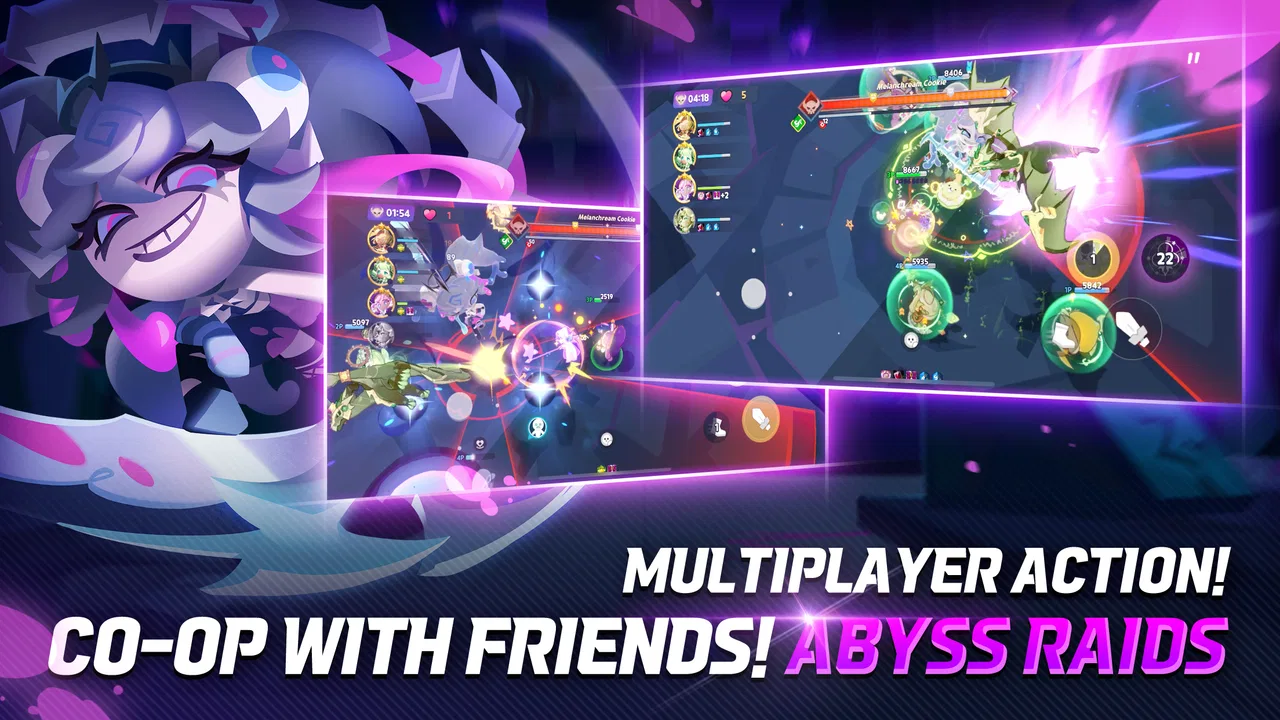
Yes, multiplayer is one of the main attractions of CookieRun: Tower of Adventures. Depending on the available modes and current updates, players can cooperate with others during selected stages and challenging encounters. Teamwork is useful because different Cookies can fill different roles, such as dealing damage, supporting allies, or controlling enemies. Multiplayer availability may depend on progression, matchmaking, and network quality.
05What devices are compatible with CookieRun: Tower of Adventures?
CookieRun: Tower of Adventures is designed for modern Android and iOS smartphones and tablets, but compatibility can vary depending on the operating system version, device model, available storage, and hardware performance. Since the game features detailed visuals and real-time action, older devices may experience longer loading times, reduced graphics quality, or performance issues. Check the official store listing before downloading.
Pros
- Fast-paced tower battles are easy to learn but remain satisfying to master.
- Distinct Cookie characters offer varied skills and useful team combinations.
- Bright animations and playful sound effects make every stage feel lively.
- Cooperative play adds a fun way to tackle difficult content with friends.
- Regular events provide extra goals beyond the main adventure progression.
Cons
- Energy limits can interrupt longer play sessions.
- Upgrading a large roster may require considerable grinding.
- Random character draws can make team building unpredictable.
- Later stages may feel difficult without well-developed Cookies.
- The interface can feel busy when managing teams
- gear
- and rewards.

CookieRun: Tower of Adventures
Gallery